
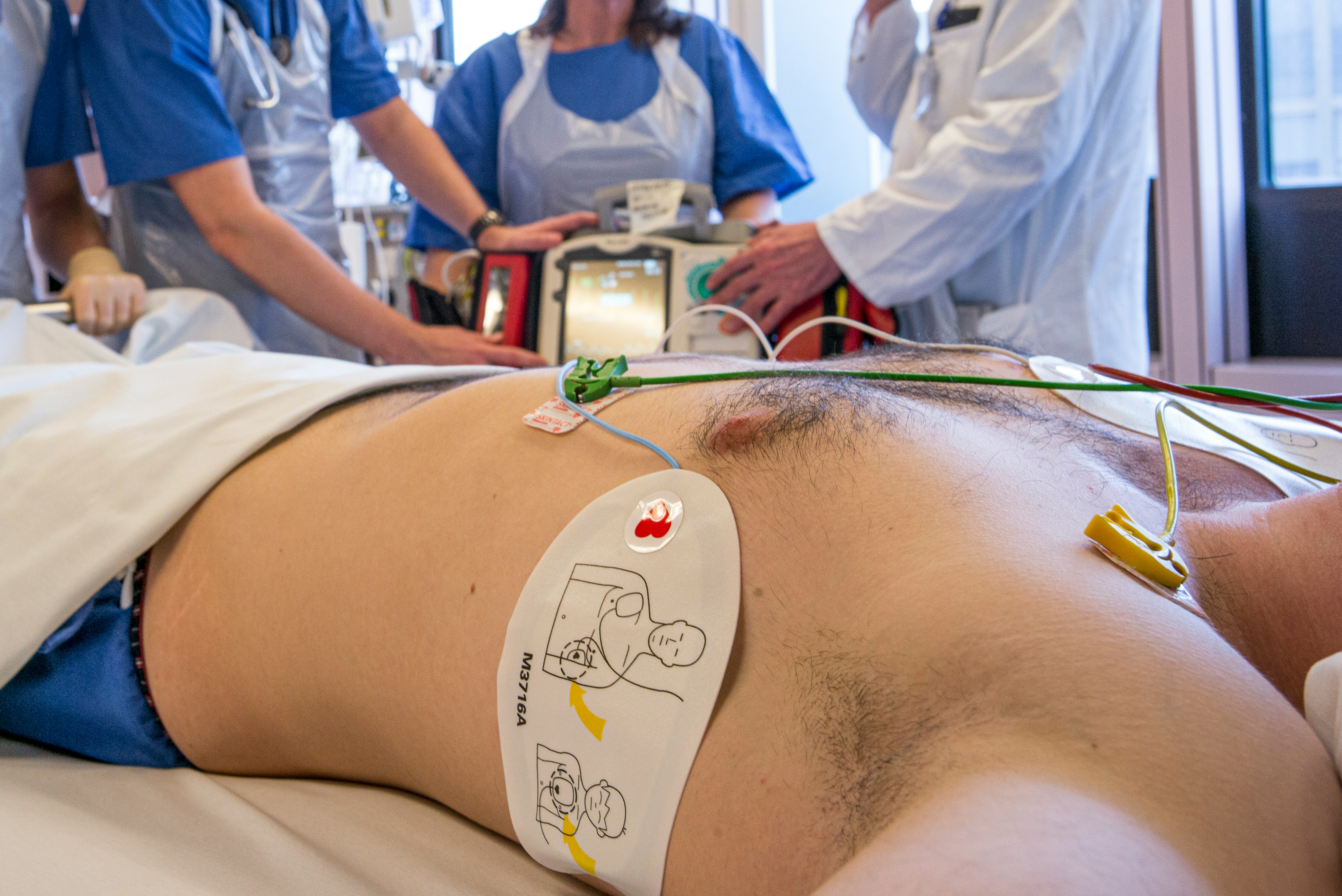
Full-time employment in my unit has always been three 12-hour shifts. And despite only being there three days a week, I somehow managed to be a part of a code blue averaging about once a week for my entire critical care training process. That was not the case for other RNs on that unit. In fact, I know a few RNs who didn’t see their first code blue until weeks after they finished training. And these weren’t all my patients, of course. But when the alarm was pulled, I was just close enough to be among the first in the room.
So, what’s a code blue?
A code blue means the patient’s heart has stopped being a good enough pump for life. AKA, the patient no longer has a pulse.
If the heart isn’t pumping, there is a very short window where “high-quality” compressions, mechanical ventilation, and the appropriate medications can keep the blood circulating oxygen in the body. This is CPR (cardiopulmonary resuscitation) or ACLS (advanced cardiac life support). It’s usually not sustainable for long periods of time.
In a well-run code blue in the hospital, a few people will rotate every minute or two doing compressions, another team member will be prepping medications, another will be administering them, yet another will be using a bag to force air into the patient’s mouth, another team member will be running the thing, while another will be tracking the actions and the timing of those actions for the whole group. Often there will be a few people running for supplies who hang right outside the room. (That’s the ideal set up and often achievable in a hospital to varying degrees of organization.) Depending on the patient’s condition, the code will last and last and last. Compressions will continue to break the ribs of the patient for the sake of blood flow. As time goes by, the patient’s body will continue to decompensate despite compressions. After 8 to 10 minutes of CPR the chances of the person ever coming back to the life they had before are pretty dismal. The reason for this is because while high quality compressions can keep blood flowing to a certain degree, it is not to the degree the body needs over time. The body (including the brain) starts to suffer additional damages.
I should say that there is a question in the back of most of our heads during a code blue: “Are we doing what’s best for this person?”
Is it a 25-year-old coming out of a car accident? The answer to that question is clear: yes. It’s go go go time. No questions. Get them back.
Is it a 101-year-old who is bed bound with end-stage kidney disease, liver failure, and chronic pain who has already been unresponsive to multiple modalities of treatment, has chronic bedsores that are bone deep and infected, etc? The answer here is also pretty clear to most of us: No, I don’t think we’re doing what’s best for that person. But we will do it if it is the family’s request.
The latter is a situation where, in my opinion, the family needs to learn to let go. I would assume the palliative team and attending physician are going to have a straightforward (though less straightforward than my last sentence) conversation with family while we work on this person’s expiring body. You’d be hard-pressed to find a doctor who’ll be more than semi-straightforward. The ones that will tell you point blank, “There’s nothing we are doing for this patient – we are only doing things to them,” are the best doctors, but they are rare.
Here’s how I try to help families in preparation for these moments:
We have two guarantees in life. One, we are going to feel things. Two, we will not survive it (life).
Consider going to a theme park – the most incredible theme park imaginable! It’s free entry for all who come! Here you can experience ecstasy and pain, elation and profound enlightenment, pure love for another as well as heartbreak. And for the most part – you’re in control of your experience through your perspective. Sounds incredible, right?! Now imagine as you enter the park the ticket taker says, “Oops! One catch: you’ll never come out of here alive. No one ever has.”
That’s us, friends. We’re in this incredible theme park together until our ride ends. And it will end. So when I’m with these family members who are facing the unimaginably complicated choice of whether to let their loved one go or not, I try to remind them that their loved one has already done the hard part. We will all die, but it’s the process of that death that is so terrifying. If someone has already gone through the guaranteed experience of dying (aka their heart has stopped) why would we make them go through that again? The hard part is over. If we’re lucky, we only ever have to go through that once.
Now let’s get more complicated. Let’s go back to the extreme examples of a 25-year-old and a 101-year-old. I would not make my 101-year-old grandmother go through that trauma more than once. If her heart stops then please let her go. Those are her current wishes and I support her fully. In my belief system, she’s going where everyone before us has already gone. She’ll be welcome there and make the most of it, as she does. My 25-year-old niece however, if her heart stopped for some reason, I would think it’s a terrible thing for her to have to experience something like this twice but there are so many moments of life still to come before her ride ends. Let’s give her the gift of experiencing those loves and joys if we can.
Make sense? Good. Now let’s get mooooooore complicated:
Will my 25-year-old niece still be herself? How long was my niece’s heart stopped? How long did her brain go without adequate oxygen? How does the MRI of her brain look? Does she have reflexes? Is she taking her own breaths over the ventilator? How is her EEG (brain scan to detect abnormal brain function and seizure-like activity)? Will she be capable of experiencing more than fight or flight states? Will she be capable of registering a moment of joy? What will her quality of life be? …These are pertinent questions. If she is no longer capable of having what she would consider a good “quality of life,” THEN WHAT ARE WE DOING FOR HER? …Are we doing what’s best?
A “successful” code blue, as I understand it, means we’ve achieved return of spontaneous circulation (ROSC). In other words, the heart is beating on its own again. That’s it. The definition of “successful” does not include quality of life, or relativity of health after the code compared to before. It also does not include the likelihood of the heart stopping again and again due to age and other diseases the person is having, etc. The definition just means the heart is beating on its own again. Even if just for a few minutes. Yay. Success.
When it comes to a loved one’s code status, or your own, there really isn’t a clear answer and there certainly isn’t a wrong answer. It’s individual. No one will tell you what it should be but hopefully I’ve helped you understand the reality of what it is to those of us in the biz. In most cases we’re not talking about a 25 year-old or a 101 year-old. Most of these cardiac arrest patients are in their 50s through 80s in my experience. Rarely will someone be younger unless they have many other health or lifestyle issues that led to their current state. But for the most part we’re dealing with people in their 50s to 80s. That said, even if you’re 25 and reading this, ask yourself these questions and COMMUNICATE YOUR ANSWERS WITH YOUR LOVED ONES. Don’t put them through having to make these decisions for you.
- If your heart stops (you have died), do you want compressions to try to keep blood pumping through your body in case your heart can be restarted? Meaning you’ll have to go through the process again at some point.
- How long do you want them to keep doing compressions? (“A person’s chance of surviving while receiving cardiopulmonary resuscitation (CPR) for cardiac arrest in hospital declines rapidly from 22% after one minute to less than 1% after 39 minutes.”)
- If you cannot breathe adequately on your own, or you cannot protect your airway, do you want a tube put down your throat and a ventilator breathing for you?
- How long do you want to stay on the ventilator? Maximum I see will often be around 14 days before they surgically put a tracheostomy tube into the patient’s neck, and a feeding tube surgically inserted through the patient’s stomach.
- If you will no longer be able to eat or breathe through your mouth, would you still want to be saved? AKA if you have a tracheostomy tube through your neck and a feeding tube through your stomach, is that a life you still want? These can be reversed over time, though even that is not guaranteed.
- What do you consider a good “quality of life?” Do not judge yourself for your thoughts on this. Everyone is different and there is no wrong answer. Your answers will also likely change with time and experience.
Please communicate your thoughts around this to your loved ones. Ask your parents their wishes and make them write them down. It will make an impossible situation somehow more manageable when (not if) that time comes. Remember, no one escapes this glorious theme park alive. So prepare yourself and your loved ones, then go ride all the rides!


Leave a Reply